What is FEM analysis?
FEM analysis (Finite Element Method) is a numerical simulation method used to calculate how a structure responds to specific physical conditions such as loads, constraints, pressures or deformations.
The principle is simple: instead of analysing a complex structure as a single body, the method divides it into many smaller elements. This makes it possible to solve the structural problem step by step and then reconstruct the overall behaviour of the model.
In yacht engineering, this is particularly useful because a vessel is made of interconnected parts, structural hierarchies and local details that cannot be assessed effectively through overly simplified calculations alone. FEM makes it possible to study that complexity with a much higher level of control.
What is the objective of this analysis?
The objective of FEM analysis is to understand how a structure is likely to behave before it is built, modified or validated.
It allows engineers to evaluate:
- stress distribution
- deformations
- displacements
- critical structural areas
- load transfer paths
- possible local weaknesses
This makes FEM analysis useful when the project requires more than a general structural check. It helps validate technical solutions, guide engineering choices and identify critical issues while there is still room to improve the project.
For a shipyard or technical office, that means having a clearer view of structural behaviour at a stage where corrections are still manageable.
What is FEA?
FEA (Finite Element Analysis) refers to the practical engineering application of the Finite Element Method (FEM).
In simple terms, FEMis the calculation method, while FEAis the analysis carried out using that method. In practice, the two terms are often used interchangeably, but the distinction is still useful because it shows that the software result is only one part of the process. The real value depends on how the model is built, solved and interpreted.
How does FEM analysis work?
A FEM analysis works through a sequence of model preparation, numerical calculation and result interpretation.
In practice, the process is not just about running a solver. It is about building a model that reflects the real structural question with enough accuracy to support the project.
In general, the workflow develops through 3main phases:
- Pre-processingis where the model is prepared. Geometry is selected or simplified, material properties are assigned, loads and constraints are defined, and the structure is set up according to the type of verification required.
- Processingis the calculation phase. Here the software solves the discretised model and generates the numerical response of the structure.
- Post-processing is where the results are read. Stress maps, displacements, deformations and local concentrations become visible, but the real task is to understand what those outputs mean in relation to the actual design objective.
What is the role of the MESH?
The mesh is the grid that divides the model into finite elements and makes FEM calculation possible.
Its role is central because the mesh directly affects how the structure is represented and how accurately local behaviour can be captured. If the mesh is too coarse, important stress variations may be oversimplified. If it is too dense without a clear reason, the model becomes heavier without necessarily improving the quality of the analysis.
For this reason, mesh generation needs to follow the structural logic of the problem. Areas with complex geometry, local discontinuities or stronger stress gradients usually require greater refinement.
The mesh is therefore not a secondary step. It is one of the elements that most directly influence the usefulness of the analysis.
What software is used?
Different FEM software environments can be used depending on the type of structure, the objective of the analysis and the required level of detail.
In general, the workflow starts from a 3D CAD model, which is then prepared for structural simulation. From there, the process moves through mesh generation, load and constraint definition, solution setup and result evaluation.
These tools can support different types of simulations, including:
- static analysis
- dynamic analysis
- thermal analysis
- non-linear simulations
- fatigue-related assessments, where required
In yacht engineering, however, the software itself is not the decisive factor. What matters most is how the structure is interpreted, how the model is simplified and whether the imposed conditions are consistent with the actual design problem.
How is FEM analysis applied to nautical design and yacht projects?
In nautical design, FEM analysis is applied to structural systems that are too complex to assess reliably through simplified checks alone.
This includes yacht and superyacht structures made of:
- hull plating
- primary members
- secondary members
- stiffeners
- supports
- local construction details
Within these projects, FEM analysis can help:
- verify structural behaviour under design loads
- identify critical areas and stress concentrations
- validate local details and structural solutions
- compare different configurations
- support technical choices before construction or during project development
Its relevance in yacht design comes from the fact that ship structures cannot be treated like generic mechanical parts. They need to be read according to their construction logic, structural hierarchy and the real purpose of the analysis.
Advantages and disadvantages
FEM analysis offers major advantages in structural design, but it does not produce useful results automatically. Its effectiveness depends on how well it is aligned with the actual structural problem.
Advantages and strengths of FEM analysis
The main strength of FEM analysis is that it makes structural behaviour visible before the vessel is built.
This gives engineers more room to improve a solution while the project is still flexible.
Its main advantages include:
- the ability to evaluate complex geometries
- better visibility over stresses and deformations
- comparison between alternative structural solutions
- reduced dependence on physical prototypes
- support for structural optimisation
- more informed technical decisions
In yacht projects, this is especially useful when the structure includes local details, large assemblies or conditions that are difficult to assess with simplified calculations alone.
Disadvantages and limitations
The main limitation of FEM analysis is that the quality of the result depends directly on the quality of the model.
The results depend on the consistency of the loads and constraints, the chosen simplifications and the ability to interpret the output correctly. An advanced solver cannot compensate for a poorly built model.
This is why FEM should not be seen as an automatic shortcut. It requires time, technical judgement and a disciplined modelling process. When the input is weak, the output becomes unreliable. When the model is built with method, the analysis becomes much more useful to the project.
Future developments of this process
Future developments in FEM analysis are moving towards more integrated and more detailed simulations.
This includes growing use of:
- non-linear analysis
- multi-physics simulations
- fatigue and durability assessments
- more advanced dynamic scenarios
- higher computational capacity for more complex models
The key point, however, is not only that the tools are becoming more powerful. It is that engineering teams need to use that power with better judgement and clearer modelling strategies. As FEM environments evolve, technical expertise becomes even more important.
Kyma’s approach
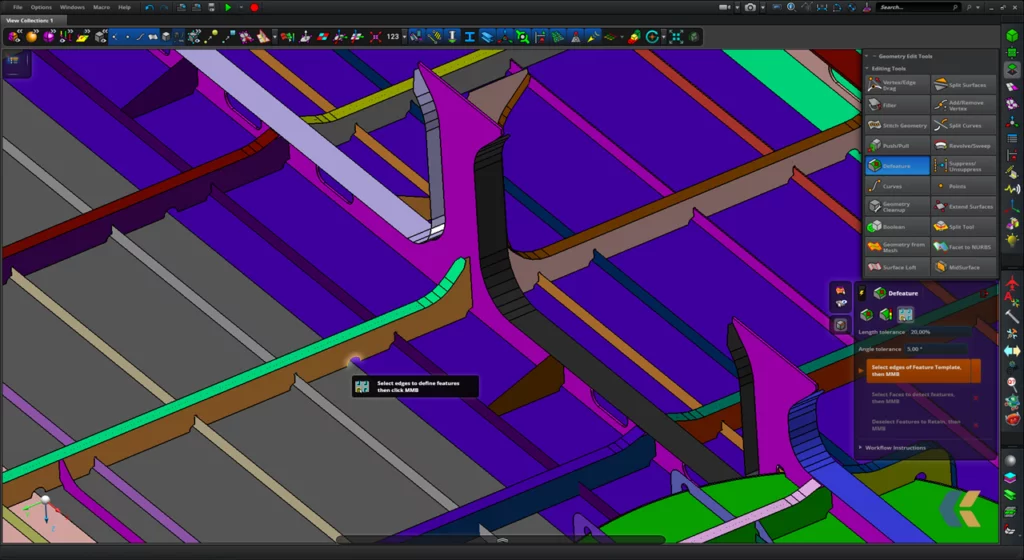
For Kyma, FEM analysis becomes useful only when it produces information that can genuinely support the project and the shipyard. That is why the decisive phase is not the numerical solution itself, but the preparation of the calculation model.
This is where the analysis can either become reliable or start to lose value. Geometry selection, simplification, structural idealisation and model breakdown all influence the quality of the result. If these steps are handled correctly, the analysis becomes clearer, more robust and more relevant to design decisions.
In Kyma’s method, model preparation is built around 3 essential steps:
- creation and import of the geometry
- defeaturing, meaning the reasoned simplification of the model
- structural breakdown according to the objective of the verification
To this, Kyma adds a specialist understanding of ship structures, which is necessary to represent hull plating, primary members, secondary structures, supports and local details in a technically coherent way.
This is what gives FEM analysis real value within the project: not as an isolated calculation, but as part of a broader engineering workflow that connects modelling, structural assessment and technical development.
If you are assessing structural behaviour, critical details or calculation models in a yacht project, Kyma can support the process with an engineering approach grounded in method, modelling and project development.