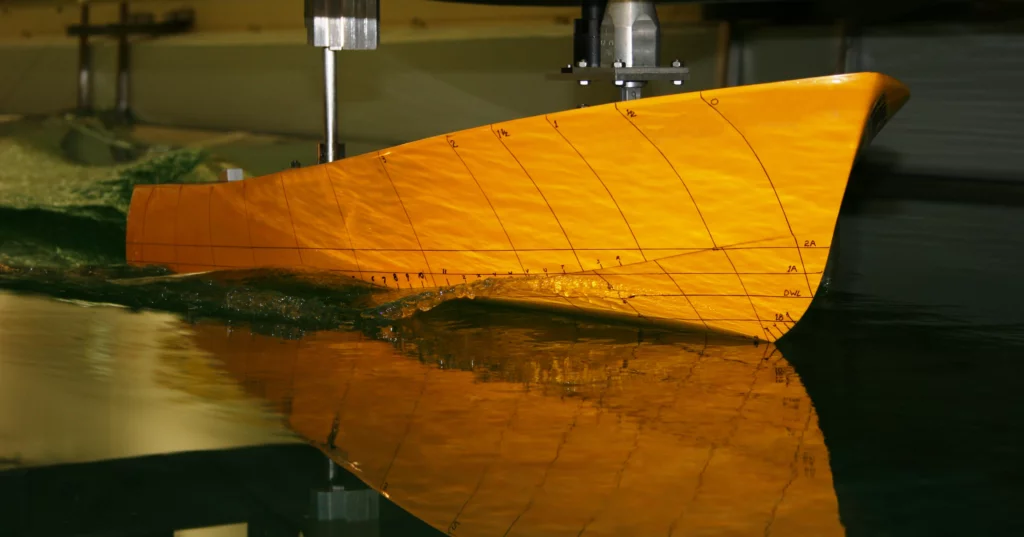
What is CFD analysis
CFD analysis is a numerical simulation method used to study the behaviour of fluids and their interaction with bodies and surfaces. In nautical design, it helps engineers understand how water and air move around a hull, a superstructure or specific components of the vessel.
Its relevance has grown because it allows complex fluid-dynamic phenomena to be studied during the development phase, without relying only on physical testing. This gives the design team the possibility to compare solutions, evaluate alternatives and support decisions with simulated data rather than assumptions alone.
What is computational fluid dynamics
CFD stands for Computational Fluid Dynamics. The term refers to the set of numerical methods used to solve, through software, the equations that describe fluid motion.
In practical terms, computational fluid dynamics makes it possible to simulate phenomena such as:
- pressure distribution
- flow velocity
- turbulence generation
- hydrodynamic resistance
- interaction between fluids and designed geometries
In the nautical industry, this is particularly useful because the performance of a vessel is deeply influenced by the way fluids behave around it. A hull does not move through water in abstract conditions, and a superstructure does not interact with airflow in a simplified way. CFD helps turn these interactions into readable technical information.
How to properly approach a CFD analysis
A good CFD analysis does not depend only on software. Its reliability depends above all onhow the simulation is set up.
To obtain useful results, it is necessary to start from a model that is coherent with the goal of the analysis, define boundary conditions correctly, choose the right level of detail and generate a mesh that matches the phenomenon being studied.
Interpretation is just as important as setup. A simulation does not automatically produce a design answer. It produces data, and those data need to be read in the correct context, checking whether assumptions, simplifications and parameters are consistent with the expected real behaviour.
This is why, in naval architecture and marine engineering, CFD should be seen as part of a wider technical process. It is not an isolated step or a purely software-driven exercise. It becomes valuable when it supports project decisions with method and technical judgement.
Which software is used?
The software used for CFD analysis can vary depending on the project, the simulation target and the required level of detail. In general, these tools are used to manage model preparation, mesh generation, solver settings and result interpretation.
That said, software choice is only one part of the equation. What really matters is the ability to build the right model, identify the relevant parameters and read the output according to the actual needs of the project.
In other words, the quality of a CFD analysis is not defined by the name of the software alone. It depends on the technical method behind it.
Application examples in the nautical industry
In the nautical sector, CFD analysis can support different areas of design and development.
One of the most common examples is the study of hull hydrodynamic resistance, which helps evaluate how the vessel behaves in water and supports decisions that affect efficiency, performance and consumption.
It can also be used to analyse:
- flows around superstructures
- airflow behaviour in specific configurations
- pressure distribution on surfaces and components
- aspects related to comfort
- interaction between fluids and complex geometries
In more advanced design scenarios, CFD also makes it possible to compare different configurations and assess the effect of geometric modifications before production. This is especially useful when the project requires optimisation, performance control and more technical support during decision-making.
Advantages and disadvantages
CFD analysis is a valuable tool in nautical design, but like any technical methodology it needs to be understood through both its strengths and its limits. Its value increases when it is applied with clear objectives and within a structured engineering process.
Advantages and strengths of CFD analysis
One of the main strengths of CFD is the possibility of studying complex fluid-dynamic behaviouralready during the design phase. This gives the project team a stronger technical basis for comparing solutions and guiding development choices.
Its main advantages include:
- the possibility of evaluating different scenarios before physical testing
- support for the optimisation of geometries and configurations
- a better understanding of pressures, velocities, turbulence and flow distribution
- the integration of simulation into a broader design workflow
- a more informed evaluation of efficiency, performance and vessel behaviour
In the nautical sector, these strengths are particularly relevant when a project requires technical control, comparison between alternatives and a moreprecise understanding of how the vessel is likely to behave.
Disadvantages and limitations
Alongside its advantages, CFD also comes with limitations that must be considered carefully.
The results depend on the quality of the model, the correctness of the boundary conditions, the chosen level of detail and the ability to interpret the output properly. A poorly set simulation can produce misleading results, even when the software is advanced.
CFD also requires time, specific expertise and accurate preparation. It is not a shortcut, and it does not automatically replace other forms of validation. Its value lies in the quality of the technical process behind it.
This is why CFD is most effective when combined with design experience, engineering judgement and a clear reading of the actual project problem.
Kyma’s approach
For Kyma, tools such as CFD analysis are useful only when they are part of a structured design process and contribute to the real development of the project. Simulation is not treated as a separate technical exercise, but as a resource that can support naval engineering decisions when it works in dialogue with the other phases of design.
This reflects a broader method in which basic engineering and detailed engineering are connected within the same workflow. In this context, analysis and simulation help improve project control, reduce ambiguity and support more informed technical choices.
Kyma’s work in the nautical sector also includes activities such as 3D modelling, 3D laser scanning, FEM analysis, hydrodynamic analysis and hydrostatic analysis. This integrated profile makes it possible to approach yacht and commercial vessel projects with a more complete technical view, where different tools contribute to better quality, precision and continuity throughout development.
If you are evaluating simulation tools within a yacht development project, Kyma can support this process with a technical approach that connects analysis, design and project development.